Resetting the balance of nature
PRINT VERSION
|
PDF VERSION
By identifying the DNA of native and invasive species, these researchers hope to get rid of unwanted plants and save our beloved horned frog.
Remember The Invaders, that old sci-fi show from the ’60s? Well, it ain’t science fiction. The invaders are here, and, “the nightmare has already begun,” says Dean Williams, ecologist and assistant professor of biology who is TCU’s answer to David Vincent, the lone man in the series convinced that alien beings are trying to take over the planet.
But unlike Vincent, Williams is not alone, and the invaders he seeks to conquer aren’t from another planet. His nemeses are species such as hydrilla and purple swamphens that have relocated from other countries and reproduced so quickly in the U.S. that they’re squeezing the native species out.
Environmental agencies, university researchers, and think tanks around the world are all too aware of the threat that plants and animals create when they escape from native habitats.
Without natural predators and controls, some introduced species run amok — usually to the detriment of natives. They steal ecosystems, hog food and sunlight, and reproduce with a vengeance, killing any species that stand in their way. And they cost big money. In 2006, estimated annual damage caused by invasives was $1.4 trillion worldwide: that’s 5 percent of the global economy.
These species don’t arrive in crafts from another galaxy. Most often, we shuttle them into new habitats ourselves, Williams says. From bright ideas (camels imported into Australia from India as helpful pack animals; purple loosestrife brought into the U.S. from Europe by settlers keen on its showy flowers) to accidents (zebra mussels from the Black Sea dumped via ships’ ballast into the Great Lakes), man has been the main culprit in species transportation.
One out of control immigrant Williams has tackled got its start through simple human inattention. The purple swamphen (Porphyrio porphyrio), a red-beaked, carnivorous bird, indigenous to Africa, India and New Zealand, is running rampant in southern Florida. It is thought to have escaped into the wild when breeders allowed their birds to roam freely in the 1990s, and it’s now trampling the nesting grounds of native U.S. wildfowl species, stealing eggs and snatching ducklings to feed its huge appetite.
A bit like Vincent shooting an alien with its own ray gun, Williams and TCU biology undergraduate, Cory Leach, are using the swamphens’ own cells to figure out how to bring them down. They’re sequencing the birds’ DNA to try and discover exactly where they came from, how dispersed they are, and how close genetically their population is, in order to find a way to stop them.
Williams and undergraduates Karen Ruiz-Roehrs and Richard Fleischer look for similar information when investigating another unrestrained interloper: the Brazilian peppertree (Schinus terebinthifolius). Imported into the U.S. from South America as an ornamental plant in the late 19th century, it’s since taken over thousands of acres in south Texas, Hawaii and Florida.
The Brazilian peppertree grows like crazy, climbing understory trees to form thickets that choke out most other plants. Once it takes hold it’s nearly impossible to kill. Cut one down and the tree just sends up more shoots — a verdant Robo-cop. Cutting, burning, flooding, or using herbicides to kill existing stands is labor intensive and polluting, says Williams. Such methods kill off non-target species, too, not exactly the desired effect.
Williams has a better idea: “Host-specific natural enemies of the Brazilian peppertree that will selectively damage the plant.” (That’s bugs, to you and me.) To find the right bug for the job, Williams must identify the exact origin of the plant he wants to kill. This means sequencing the DNA of hundreds of trees in Brazil. When he finds a match to the Florida trees, he’ll use the same insects that control the plant in its native range — importing the tiny, specialized hit men to kill the trees naturally.
Closer to home, Williams and grad student Amber Grajczyk use molecular methods to search for ways to whack another weed that plagues Texas ponds and lakes: Hydrilla verticillata. Hydrilla is “a serious aquatic weed that clogs waterways, destroys aquatic habitat, and stops boat traffic,” said Williams, who hopes that DNA will be the key to its demise.
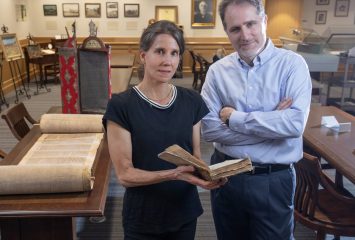
Finding the secrets of DNA can help to rout out invaders, but it can also be used to save native species. Williams and assistant professor of biology, Amanda Hale, who also happens to be married to Williams, use DNA fingerprinting in a quest to rescue TCU’s beloved horned frog. The horned frog (actually a lizard, Phrynosoma cornutum) was once prolific throughout Texas, but is now confined to the west Texas desert.
Biologists don’t know for certain, but believe that one cause of horned lizard decline is the imported red fire ant. Fiercely territorial, the ant is winning turf wars against native red harvester ant colonies, which the horned frog relies on for 70 percent of its diet. The imported ant not only kills the harvester ant queen, preventing new colonies from forming, but also may prey on horned lizards or their hatching eggs. Man is another probable contributor to fewer horned lizards: insecticides we use to terminate the fire ant kill the harvester ant, too.
Reasons for the horned lizards’ decline may lie within its genes. Genetic diversity within and among populations enables them to adapt to local environmental conditions, increasing their chances of survival. With a grant from Texas Parks & Wildlife and hundreds of DNA samples of wild lizards collected by volunteers around the state, Hale, Williams and biology undergraduate Cory Leach look for levels of genetic diversity, dispersal patterns, and population structure. “Up until now, we have known virtually nothing about these aspects of horned lizard biology,” said Hale. “Genetic data can be used to estimate these important parameters and guide population management and restoration efforts.”
While Williams’ main focus is invaders, Hale studies natives. One of her passions, aside from horned lizards, is mountain-meadow fringed gentians, an alpine flower with little room left to climb as the climate grows warmer. Hale and Williams have also collaborated on several DNA investigations of birds in Costa Rica.
One species they’re both passionate about is grassland nesting birds. Head of the bird and bat team for the Institute for Environmental Studies’ international project on wind research,Hale and post-doc Kris Karsten monitor mortality rates of flying animals at the Wolf Ridge wind farm in Munster, 80 miles north of Fort Worth. This spring, after counting carcasses and adjusting protocol to allow for biases, researcher efficiency, scavengers and seasonal vegetation, Hale hopes to standardize mortality assessments that could be used at other wind farms.
On the same property, Hale and Williams engage in bird research of their own, on the behavioral ecology of breeding grassland birds.
“There is a crisis in grassland birds in this country,” said Hale. “In the midsection of the U.S., the prairie lands, the birds are disappearing.” One of the biggest problems is habitat loss from the farming of biofuels.
But in terms of habitat destruction, how much greener is wind power? Prairie is also sought after for planting wind turbines. Does turbine activity keep birds from nesting and brooding on their usual territory? Hale and Williams hope to find out.
“We may discover that wind turbines have little or no impact,” said Hale. “We may even discover that they are a better alternative than disruption of the land for planting crops.”
Whether importing non-natives across borders or encroaching on biodiverse ecosystems with our houses, factories, crops, mines and landfills, man has upset the balance of nature. Sometimes it looks like The Invaders are here, and they are us. Luckily, there are those we might refer to as The Protectors: ecologists such as Williams and Hale who work to bring the earth back into equilibrium. It’s not too much to say that they deserve our thanks and praise. At a time like this, they are the planet’s only hope.
Contact Hale at a.hale@tcu.edu and Williams at d.williams@tcu.edu.
Comment at tcumagazine@tcu.edu.
Amanda M. Hale is an assistant professor of biology. She studied at Purdue University for her undergraduate degrees and master’s and received her doctorate at the University of Miami in 2004. Her research interests are behavioral ecology, conservation biology, phylogeography and systematic. She joined TCU in 2008.
Dean A. Williams is an assistant professor of biology. He earned his bachelor’s degree at Coe College, his master’s at the University of Alabama and his doctorate at Purdue University. His research interests include conservation genetics, behavioral ecology, and invasive species
He joined TCU in 2008.