Examining judicial systems
PRINT VERSION
|
PDF VERSION
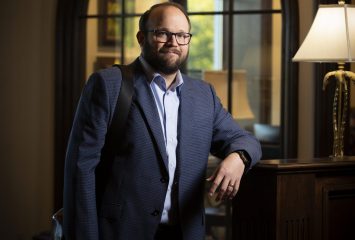
Professor compares courts around the world in upcoming book
Mary Volcansek invites you to play make-believe for a moment: Imagine that the U.S. Supreme Court functioned like Argentina’s constitutional court. During the recent White House transition from George W. Bush to Barack Obama, the Supreme Court would have started voiding laws right and left.
“They would be going like gangbusters,” says Volcansek, TCU political science professor and former dean of the Addran College of Liberal Arts.
Here’s the strange thing: The judges aren’t necessarily motivated by a personal agenda against the outgoing president. It’s just that in Argentina’s government, the nation’s top executive presides for only one six-year term with no possibility of re-election. Voiding laws is an affront to the president’s power, and the normally placid judges in this South American Republic know it. The judges, therefore, take the opportunity to flex their muscles whenever the presidency is in a state of flux.
If you think judges in Argentina behave strangely, just imagine how you would act if you were a judge in Bulgaria. Political opponents there threatened judges with attack by hydrochloric acid. How’s that for pressure? You have two choices: Kowtow to the opposition or risk having your face burned off.
These countries aren’t even the oddballs. The United States actually has the most unusual courts in the world, Volcansek says. Yet, scholars have long insisted on forming theories based on the U.S. system and applying them to the study of courts in other countries.
“If you go in thinking all courts are like the U.S., you really have a distorted view of what the role of the courts are,” Volcansek says.
Another problem Volcansek has discovered is political scientists’ tendency to focus on one nation (or group of nations) at a time when they study non-North American courts. This limits researchers’ ability to derive more than a partial view of the similarities and differences among the many courts found around the world.
To address these and other issues, Volcansek is writing a book tentatively titled Judicial Politics: A Comparative Lens. The text, which she expects to complete this summer, will synthesize previous scholarly works to generate new theories on how courts and justices behave outside of a North American context.
Not only will Judicial Politics cover a broad scope of countries and clear up misconceptions about how those nations’ courts — especially constitutional courts — operate, but it will also take an in-depth look at international courts, those not under the jurisdiction of a single country.
“There’s an absolute alphabet soup of them,” Volcansek said of the myriad international courts, including the little-studied Court for the International Settlement Investment Disputes.
Volcansek started working on Judicial Politics while on sabbatical last school year. She started by gathering previous studies. Her home filled with dozens of books and a stack of journal articles four feet high. As she took stock of the exhaustive data, several patterns began to emerge.
One important trend she found is that judges are not appointed for life in any country but one: The United States. Some are also appointed for life in Great Britain, but no constitutional court judges have life tenure. There is at least a mandatory retirement age elsewhere. This is significant because how judges are selected and how they are removed are two major ways that judicial independence is asserted. Because U.S. Supreme Court justices — who are appointed by the president and confirmed by the Senate — serve a life term, they are free to follow their conscience without having to bow to the pressures faced by judges selected to finite terms.
Take Italy, for example: Constitutional judges there are appointed for one term with no possibility of reappointment. As a result, the judges must act with an eye on attaining a lucrative job after they leave the court. One Italian judge who stirred controversy while in office lost the position he had lined up at a prestigious university because officials there no longer wanted to be associated with him.
“No other country appoints judges for life,” Volcansek says. “I think it points out how exceptional the United States is and how foolhardy it is to apply a U.S court theory on other courts around the world. Because our justices serve for life … our justices can truly act independently.”
Another fascinating trend Volcansek discovered is the rise of constitutional courts in all corners of the globe. Egypt, Kuwait, Thailand and Mongolia are among the countries that have installed courts empowered to interpret a nation’s constitution and strike down laws that contradict that social contract. These nations chose to create constitutional courts, Volcansek says, because they see the value in having a sort of insurance policy to ensure opposing political parties are forced to play by the same set of rules.
Constitutional courts are especially popular among the various emerging democracies of Europe. As communism declined in Eastern Europe in the 1980s and ’90s, the United States actively tried to influence the spread of constitutional law by sending political scientists and law professors into these infant democracies to act as constitutional consultants, Volcansek says.
“For a long time, you couldn’t go to a cocktail party without someone talking about what he or she did to design the constitution in Bulgaria or Poland,” Volcansek says.
Although constitutional courts are granted certain powers, their authority has often been subject to sudden and arbitrary change. In countries that don’t have a long track record of democratic rule, powerful politicians can alter the rules as they go, Volcansek says. For instance, Russian President Boris Yeltsin became fed up with political rivals and decided to dissolve the parliament and courts.
“If the politicians don’t like what a court decides, they can undo it,” Volcansek says.
Some constitutional courts appear strong, but only in certain situations. In some countries, special courts are set aside to deal with touchy political issues. Heads of state use the special courts when they are uncertain that the constitutional courts will give them the results they want, Volcansek says. Egypt, for example, has a strong constitutional court that has gone head to head with Egypt’s president, but a strong special court, called a security court, tries political prisoners. Volcansek says Egypt’s special court is similar to the Guantanamo special commission created under the Bush administration.
Sometimes judges don’t use their power out of fear of retribution. In the early days of democracy in Hungary, judges overturned a number of laws. Those assertive judges were not reappointed. Today, the Hungarian constitutional court takes a rather hands-off approach to judicial review. In Colombia, judges received pressure not to extradite prisoners to the United States. The pressure came not from politicians, but from drug cartel heavies who shot up the court room.
On the other hand, many nations’ constitutional courts have made some recent notable rulings. For example, Thailand’s constitutional court in 2008 ruled that Prime Minister Samak Sundaravej had to resign because it determined he violated a law prohibiting the nation’s top executive from being paid for outside work. The violation occurred when Sundaravej made a paid appearance on a television cooking show.
Volcansek’s book also examines the role of international courts. The numerous international courts include The International Court of Justice, the International Criminal Court, the European Court of Human Rights and a number of regional courts. Several of the European-based courts have a good deal of power, as does the court for the World Trade Organization. But they face severe limits when dealing with economic gorillas.
The United States won a pair of lawsuits against the European Union in an international dispute, but the judicially required actions don’t necessarily follow, Volcansek says. International courts don’t even bother to come after China, according to Volcansek.
“Nobody sues China,” Volcansek says. “You don’t want to alienate China.”
Even though the American court system has its shortcomings, Judicial Politics demonstrates that if there’s anything courts around the world have in common, it’s that each has its oddities and imperfections.
“Believe me, it’s a wild set of variations from what we´re accustomed to,” Volcansek says.
Contact Volcansek at m.volcansek@tcu.edu.
Comment at tcumagazine@tcu.edu.
Mary Volcansek is political science professor and former dean of TCU’s AddRan College of Liberal Arts. Her teaching interests include judicial politics, public law, comparative judicial politics, Western European politics, Italian politics and the European Union. She serves as the Executive Director of the Center For Texas Studies (www.texasstudies.org). She is the author of five books and four edited volumes, as well as more than 30 articles and book chapters. She founded the Florida International University study abroad program.