SPRING 2009

Juggling molecules

4/10/2008 12:19:35 PM | by Nancy Allison | PRINT VERSION | PDF VERSION

Phosphorus philosopher Jean-Luc Montchamp teases new compounds out of old.

You mean the guy with the beard?" laughs Jean-Luc Montchamp into the phone. Some crazy, near-sighted interviewer has just asked TCU´s associate professor of chemistry if that´s him in the background of his Web page. Picture a dark room with a Gothic ceiling, shelves filled with ancient beakers and tools. An awe-struck granddad in leggings and scruffy robe kneels in front of a glowing bulb of liquid, the only source of light in the room.

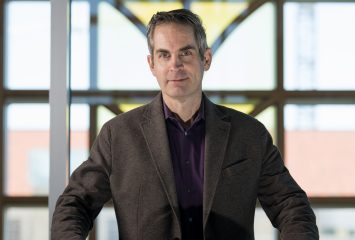
"Er, no. That´s not me," says the clean-shaven, 41 year-old Frenchman, looking around at his own brightly lit lab with its nitrogen cylinders, rotoevaporators, solvent stills and NMR spectrometer. For the curious, the Web image is a painting of Hennig Brand, an amateur alchemist who "discovered" phosphorus in 1669 while searching (as all alchemists did) for the elusive philosopher´s stone.

Montchamp assures the caller that chemistry has moved light years away from alchemy. But has it, really? Aren´t chemists still performing a kind of magic, switching the basic building blocks of matter around to make stuff that didn´t exist before?

Underneath all those molecular tinkertoys covering Montchamp´s Webpage is a man on a quest. The difference between Montchamp and Brand — give or take a few hundred years, some facial hair and the scientific method? Brand went looking for compounds; Montchamp makes them himself.

He’s one of a handful of experts in phosphorus chemistry in the world, but he doesn´t like to say so. He’d rather talk about the work he´s trying to do: "Make compounds that have the possibility of improving the quality of someone´s life."

He´s synthesized precursors to everything from anti-cancer, anti-seizure and bone density drugs to flame-retardants, fertilizers, and pesticides. He´s collaborated with chemistry department chairman Jeffery L. Coffer to develop coatings for medical structures such as silicon nanowires.

What he hasn´t done yet he can only hope for, as the ancient alchemists once prayed to find the philosopher´s stone: "If I´m lucky I might eventually make a compound that will cure someone."

One group of compounds Montchamp is excited about has potential for treating central nervous system disorders.

Conditions such as epilepsy, drug/alcohol addiction, and memory loss due to Alzheimer´s disease are all influenced by the under- or overstimulation of gamma-aminobutyric acid (GABA), the chief inhibitory neurotransmitter in the brain. Montchamp´s compounds modulate GABA receptors, proteins on the surfaces of nerve cells that normally work to keep the brain´s messaging system from overloading.

He moves from brains to bones with another type of phosphorus compound: bisphosphonates. Those already on the market, such as Fosomax and Boniva, are crucial to the estimated 44 million Americans who have osteoporosis, low bone mass due to cancer treatment or bone disease. Bisphosphonates slow down bone loss by interfering with osteoclasts, enzyme-secreting cells that break down bone mineral.

While bisphosphonates help to prevent bone fractures, "there have been some complaints about side effects," said Montchamp. So he came up with a compound that might work at lower dosages. Unfortunately, the pharmaceutical company involved moved their testing center to India, essentially ending the investigation.

So Montchamp changed gears, or rather, juggled molecules. He explains: "Bisphosphonates have many applications, according to their detailed molecular structures. They can also be used against parasites, for instance. Some are cholesterol-lowering agents. Some are anti-cancer compounds in their own right."

A few of the anti-cancer phosphorus compounds he has synthesized relate to N-phosphonacetyl-L-aspartate, better known as PALA, a metabolic inhibitor.

Normal cells divide and multiply; cancer cells divide and multiply like crazy. PALA works to zap multiplying cancer cells by blocking the tri-functional enzyme CAD, crucial to manufacturing DNA.

"Inside the cell it´s a bit like a car factory," says Montchamp. "You have steel at the beginning, and a car at the end. Stop the machines (block the enzyme) and you can´t make the car."

Asked how he goes about building new compounds, he makes it sound easy: he reads the literature, knows what is already out there and how it seems to be working, and tries to improve on it. "There´s no need to reinvent the wheel. You use the scientific method: ask questions and answer with experiments."

Still, it´s a hard row to hoe. "My compounds are precursors to drugs, not the drugs themselves. Even if I synthesize a compound in my lab, and even if this shows positive preliminary results, there is a very long way to go before it could be used."

Typically, it takes around 12 years from synthesis to clinical trials to drug approval and use. But the lag time doesn´t daunt him.

Neither does applying for funding. In the ten years that he has been teaching at TCU, Montchamp has applied for and received over $1.6 million in grants for his phosphorus research, including $300,000 in indirect costs to TCU.

If the process is sometimes frustrating, (even Montchamp doesn´t get every grant he applies for) he balances that against being free to pursue an idea. Now a proud U.S. citizen, Montchamp explains: "I moved to this country because I knew I´d have more intellectual freedom, and that is priceless to me. In France, research is pyramidal; here in the U.S., I am much more my own boss."

Independence means there´s more to risk, but more to gain, too. One new Montchamp compound seems destined to make him a household name — not so much for what it does, but for what it doesn´t do.

Greener Pesticides

In November 2008, the Center for American Progress identified 101 of the most dangerous industrial plants in the country, where accidents or terrorist activity could result in millions of deaths. The most dangerous chemical they identified by far? Chlorine.

Chlorine gas, first developed as a weapon by the Germans in 1915, reacts with lung tissue and can cause cell damage, asthma or death. These days, it is used to purify much of our drinking water.

However, more than 70 percent of the approximately 12 million metric tons produced each year in America isn´t used to make our water safe. Most of it is used for industrial purposes such as bleaching paper, producing plastics, manufacturing circuit boards — and making 50,000 tons of Roundup® herbicide.

To cut down on chlorine storage and transportation, the Center for American Progress report suggests using alternatives to chlorine gas at water treatment centers, such as bleach, ozone or ultraviolet light.

If policy makers ever get truly serious about phasing out chlorine, they will tackle the voracious chlorine-guzzler phosphorus trichloride (PCl3), — the key ingredient in Roundup — and they will turn to green chemists like Montchamp for help.

Instead of making herbicides with (PCl3), a process that begins with chlorine and ejects it as a waste product, Montchamp uses hypophosphorous acid and H-phosphinates to create the same final compounds. He is still seeking the funding he needs to continue this promising research.

Teacher/Scholar

Growing up in Lyons, France, Montchamp gravitated to math and science, he says. "I always wanted to know how things worked." But he also wanted to know how to think. He attended night school to study philosophy, and still reads his favorite philosopher, Blaise Pascal, although "sadly, not often enough."

A man who spends his life improving on nature might well come to think pretty highly of himself, but Montchamp is a modest man. Maybe he´s taken to heart the words of Pascal, who said: "Do you wish people to think well of you? Don´t speak well of yourself."

Answering the question, “Are you famous?” he responds: “Although I am pretty well-known in the phosphorus community, I am — and will remain — a little guy, a lowly chemist. What truly makes me happy, aside from being free to think and create, is when other researchers use my chemistry, or when I make a small positive difference in a student´s life."

At TCU, Montchamp has a reputation for being tough. "My students thought I was mean because I said to stop Googling and mentioned the library, the place where they have these things called books with actual pages in them," Montchamp says with a grin.

"I like the blackboard and a piece of chalk. That is how I learned, and it worked for me." It worked for Shelby Sutcliffe, TCU honor society graduate, too. She chose Montchamp for the Mortar Board Society´s annual Preferred Professor Supper in 2004.

Sutcliffe, a pre-med student who was terrified of having to take organic chemistry, remembers Montchamp´s unfailing faith in her ability to master the material. Her experience in his class inspired her to major in chemistry. And in her speech, she championed Montchamp, saying that he "doubled" any effort his students made, "spending time leading additional tutorials, answering desperate emails before exams and hundreds of questions posted online."

Last November, Montchamp was one of the judges at Harmony Science Academy´s science fair in Fort Worth. Why did he do it? "I´m a teacher first of all, and it´s important to encourage kids, to see what they are doing. They need, as all citizens need, to be interested in science. It´s dangerous not to be."

As to his favorite thought by Pascal, Montchamp quotes it easily by heart:

"L´homme n´est qu´un roseau, le plus faible de la nature; mais c´est un roseau pensant." ("Man is only a reed, the weakest in nature; but he is a thinking reed.")


Contact Montchamp at  j.montchamp@tcu.edu.

Comment at tcumagazine@tcu.edu.

Jean-Luc Montchamp was born in Lyon, France..  He completed his undergraduate studies at the Ecole Superieure de Chimie Industrielle de Lyon (ESCIL), now known as CPE.  He obtained his Ph.D. from Purdue University in 1992, under the direction of Professor John W. Frost.  After some postdoctoral experiences at Michigan State University, and at the Scripps Research Institute, he returned to Purdue University for a postdoctoral appointment with Professor Ei-ichi Negishi.  He became Assistant Professor at Texas Christian University in 1998, and was promoted to Associate Professor in 2004.  He became a US Citizen in 2004.

His research interests include: 1) the development of environmentally benign methodology for phosphorus-carbon bond formation, especially the invention of new catalytic reactions using hypophosphorous derivatives; and 2) the medicinal chemistry of phosphorus-containing compounds in general, and anticancer agents in particular.